
Wednesday, April 22, 2020

Wednesday, April 1, 2020
Cambridge 2015
For a number of years the family attended the Cambridge Folk
Festival and I wrote a post each year about the event. By accident I stumbled
across the post that follows that somehow missed out on being republished.
Cambridge 2016, 2017, 2018 et al all got a reprint here, but the first one
didn't. It was in a folder covering religious history, but how it ended up in
such an incongruous place is anybody's guess. Whether it is worthy of
resurrection is debatable, but here it is - our very first experience of Cambridge.
The fact that we returned year after year means it can't have been all that bad
an experience.
So the extended Occasional family went to the
Cambridge Folk festival last week - four days of an eclectic mix of music, and
still the most prestigious folk event in the UK, running now for over fifty
years.
In America the quintessential folk event was
the Newport folk festival, where Bob Dylan horrified purists by playing an
electric guitar in 1965, and “folk” started to embrace a lot more than nasal
protest. It led on to events like Woodstock. You may remember the film of Woodstock.
What sticks in my mind from that movie are the performances by heavily pregnant
Joan Baez looking radiant, and Richie Havens and Joe Cocker both stoned out of
their minds. And the mud. And the “state of emergency”. (It rained.) It didn’t
of course change the world, and the next major festival had a member of the
audience killed by Hells Angels in front of the stage while the Rolling Stones
were performing. That was sort of goodbye to the 60s – peace and love and all
that - and a dubious hello to the 70s.
For all its pretentions, folk music of course
changes very little. It makes some of us feel good temporarily, and on occasion
it makes people think. Nationalistic and religious music probably has a far
greater effect on those with a predisposition. But that is about the limit of
its influence. But feeling good temporarily is OK with me.
But I have to say that Cambridge this year made
us feel good.
Just the look of the place made you feel
good. There were about ten thousand visitors, and most of them were there for
the long haul. In the circumstances, the venue was extremely clean. Now
festivals aren’t exactly known for this, but folk sort of blends with a
“friends of the earth” mentality, so it is all pick up trash and recycle and
save the planet while you are about it.
Perhaps one look has changed a bit since
my last major festival a few years ago. Fashions change. A few years ago it was
all portly men with bad cases of slipped chest or brewer's goiter - with bald
heads and incongruous pony-tails as compensation, and women of a certain
earth-mother shape wearing tents. (I am reliably informed that that should read
Kaftan.) But now there are lots of younger people, sporting wispy facial hair,
bowler hats, midi-shorts and snake tattoos on lower legs. And that's just the
women...
Even with my T-shirt showing me to be a
self-conscious child of the 60s, I felt somewhat improperly dressed. But of
course no-body noticed.
And of course we camped. Normally we
are used to luxury glamour camping (known as glamping) but this time managed
with borrowed tents that were small but at least you could stand up in them. We
had airbeds that gently settled down flat, battery lights, blankets, our trusty
eReaders and an interesting contraption that Mrs O in a misguided moment bought
online called a bog in a bag. No - don't ask.
We also brought away with us some strange little festival seats that we also bought online. Basically these are seats without legs or feet. You lay them on the floor and with straps holding the seat and back together you just sit down and lean back… As I surveyed the stars with my legs in the air, I was somewhat relieved that my glass of red had not been in my hand at the time. Mrs O gave up immediately, and trotted off to the campsite shop for a luxury (i.e. extremely expensive) proper folding recliner. I didn't need it, I was fit, I was able, lot of fuss about nothing... I lasted another half hour and trotted off to buy one myself. We have loads of the things at home, but home was over two hundred miles away - the need was NOW. The youngsters - daughter and son in law - borrowed our original seats and managed a lot better than we did with them.
And I have to say it made a great difference. We couldn't sit inside the huge marquees, but could sit on the grass outside and watch a little figure in the distance, or see the action close-up on video screens. I have reached the age when this is fine. I haven't QUITE reached the stage when staying home watching it on TV is preferable - but I'm getting there...
As with most festivals there were workshops for juggling, face painting, willow weaving, mysterious healing rituals, unicycle riding, and playing obscure musical instruments. There were numerous outlets for clothes I wouldn't be seen dead in, strange jewelry, esoteric fast food for the pretentious palate, said obscure musical instruments, and even one stall doing a roaring trade in ear protectors. Pardon? I said DOING A ROARING TRADE IN EAR PROTECTORS! There were CDs galore, a vinyl resurgence, and musically, four tents with stuff going on in all of them most of the time. So you had to switch around to see who you wanted to see.
So what stays in the memory now we are back at my daughter's and have had much-needed showers? Well, there was a young lady named Amy Goddard there who we have bumped into before. A late night sing around hosted by a local school teacher, some of whose former students were in the audience, which led to some interesting moments. Then there was sitting in the sun listening vaguely to new wave folk hopefuls, while wrestling with the intricacies of Pittsburgh cemetery burial registers. As you do. And funny little things like one singer having an extra couple of minutes and doing Stand by Me, and the whole audience joining in. In case you wonder what on earth a Ben E King song has to do with folk music it can be traced back to a hymn written by Charles Albert Tindley, the son of a slave who became a Methodist minister. Another of his hymns evolved into the civil rights anthem We Shall Overcome. (Pass the Trivial Pursuit board please, that’s surely worth a plastic wedge - or cheesecake as we call them here.)
I am not going to trot out a review of
all the performers, many from America, who appeared; but there are two I must
mention.
The headliner on the Saturday was Joan Baez.
Her heyday was when American teenagers and college students suddenly
“discovered” folk music in the early 60s. It had been there all the time, but
its general left-wing sentiments didn’t sit too well with mainstream America in
the 50s. But suddenly there was Bob Dylan, impersonating Rambling Jack
Elliott’s voice, and putting new words to old tunes, just as Woody Guthrie had
done before him, and a number of female singers. My favorite at the time was
Caroline Hester. She had been a friend of Buddy Holly – she went back THAT FAR
– and sang in a Texas twang with a huge vocal range. She sometimes went
off-key, but her music was REAL. Joan Baez had a voice that was very pretty; too
pretty for me. (I felt I wanted to throw a custard pie at her at times.) But as
she got older and her voice got more “lived in” she got more interesting. And I
have to say that her one hour set was good - very good. In her mid-70s she can
still hit the notes. I have heard some folk icons from her era that really
shouldn’t be let out of doors nowadays, but Mrs O felt she had been magically
transported back to the 60s.
And a bonus for me, she actually sang a John
Stewart song “Strange Rivers.” Her recorded version from 20 odd years back
changed the last line and messed up the point of the song, but how many people
really listen to lyrics anyway? And as Stewart said in one interview, the
royalties helped him pay his gas bill.
The second highlight was an old favorite of
mine, The Ukulele Orchestra of Great Britain. A troupe of men and women all
playing ukuleles of different sizes, in ultra-respectable evening dress – doing
classical, rock, punk, grunge, as well as folk – you name it. All with a
completely straight face, but amusing patter in between. For me this time the
highlight was The Who’s Pinball Wizard done in the style of a British Sea
Shanty - complete with the obligatory finger in one ear.
I am a great fan of bonsai
guitars - it's the not having to struggle with more than four strings that does
it for me - but they make real music out of it. So I live in hope. I sometimes
do a parody of Old Time Religion. My uke verses go something like:
You learn music now in layers
You learn music now in layers
Even ukulele players
I’m a ukey player slayer
And that’s good enough for me
This song is three chords heaven
Try out G and then D7
Throw in C and G again then
And that’s good enough for me
Gimme that old time religion...etc.
But I digress.
But the less than burning question is - did Occasional sing? Well, yes,
in a late night club tent, and suitably mellow he was manoeuvred into an offer
he couldn't refuse by his daughter, and sang twice. Both were John Stewart
numbers. A couple of years ago now, my daughter recorded me on one of them and
made up a slide show, and posted it to YouTube. Fortunately without my real name,
I remain generally anonymous. Although at the time, news got out locally.
I have probably told this anecdote before, but you have to remember that
old people repeat themselves - so get used to it - I had been booked for a few
days' official visit to a congregation to give talks and the like. I turned up
at the Hall on the first night, resplendent in smart suit, collar and tie,
orthodontist smile, and briefcase of necessary equipment. I was greeted by
someone who I have known for rather a long time. He pointed and said LOUDLY -
"Hey - I heard you on YouTube..."
All heads turned.
There followed a pause and the best of all put-downs...
"The pictures were good..."
Saturday, January 11, 2020
Sleeve notes
(Sleeve notes for a prospective extended play recording)
In another life I had experience in public speaking,
on many occasions to crowds of thousands of people. But nothing prepared me for
being dragged by my daughter to a folk club and being asked to sing a Welsh
ballad at a rather venerable age. My confidence disappeared at the first croak.
If only the floor could open up allowing the singer to disappear before
lurching into verse three.
But I got through it. We visited more folk clubs and
my daughter’s career as a singer-songwriter took off. I got to singing with her
on certain songs, and decided that I should have done all this decades before,
rather than just being a couch potato listening to folk sounds on shellac,
vinyl, cassette and CD – let alone the more recent trusty iPod. It is good to
sing. It makes you feel good. How it makes the audience feel is – er –
variable, but having heard and seen all the others on the folk scene there
seemed room for a wide variety of people to enjoy themselves this way.
Make a CD my daughter said. Well, I’ll give it a go.
I will pick some of my favourite songs, those actually completed in a folk club
environment. So here they are.
And remember that if you dislike the sounds, CDs can
make good table mats and when strung together have been known to frighten birds
away from the fruit and veg.
As an ancient writer once noted (Ecclesiastes 1:2)
vanity, all is vanity.
Coyotee
I heard Pete Seeger sing this many decades ago.It’s
a song by Native American activist Pete Lefarge about the attacks on the animal
and its environment. Not one to attempt “live” if you know what’s good for you.
Go to work on
Monday
I heard Roy Bailey do this song at the Wickham Folk
festival. Roy’s age when he sang it (even older than ME) and the fact that the
song is only two chords made it most appealing. It is one of those songs where
the audience never fails to join in. Try it.
Bright Star
Shining
For several years running we were able to visit the
Perthshire Amber folk festival run by Dougie Maclean. One of his regular guests
was Buddy McDonald, a seasoned singer-songwriter from Nova Scotia. We also
attended a song-writing workshop by him. This is one of his songs. The track
also features Hannah Fisher on fiddle who we met at the same festival; with the
wonders of modern technology she put down her part at home on the Isle of Mull.
We never did hear Buddy sing it, but he kindly emailed the chords. It’s a really
nice song, the long and winding road, that sort of thing.
Merrie Old
England
A modern take on what sounds like an old song and an
old theme. Roy Bailey nailed it. It’s a song of disallusionment, as the
idealistic younger generation get their hair cut, take out mortgages and join
mainstream, and the problems sort of remain the same for a section of society.
Alas, there are no real solutions offered.
I Wanna be Elvis
I heard this almost throwaway song by John Stewart
on a bootleg live performance tape. I emailed John about him recording it and
actually got an email back. It was coming out on a forthcoming release, which
of course I obtained. I love singing it live at folk clubs because it’s only
three chords and the audience immediately pick up the chorus “Uh-huh, yeah,
yeah, yeah, yeah.” Move over Shakespeare…
Dreamers on the
Rise
This has been my favourite John Stewart song since
first hearing it in the early 1980s. The best version I heard was the one
recorded on the Last Campaign album with Chuck McDermott singing harmony. I am
very pleased to have Chuck on this recording, thanks to the wonders of the
internet. My daughter, Amy, also sings on this version. We have recorded it
before, just the two of us, as well as singing it numerous times at gigs. It’s
a song about the ups and downs of a lasting love affair.
Eyes of Sweet
Virginia
This is a John Stewart song about loneliness “on the
road.” Amy and I sang this together perhaps more than any other song, but she
had the opportunity to sing it with John Stewart’s old singing partner, Chuck
McDermott when she recorded it professionally. Who can blame her? But here we
are, the two of us, live at a folk club, “hang on dreams, you ‘aint seen it
all, but I don’t want much, I just want it all…”
Wimoweh
Pete Seeger first heard the recording of Mbube by
Solomon Linda and his Evening Birds in the 1940s. Mishearing the title as
Wimoweh, he did it with the Weavers. I then heard it on Radio Luxembourg by the
Weavers with a Valve Portable Radio the size of large brick clamped to my ear.
I can’t exactly say the rest is history, but I love attempting this song with a
well-contented audience. I think it was the Oysterband who said, the more you
drink, the better I sound… Just start
off in the right key, otherwise it becomes Wimo-screech, and for once –
blissfully – don’t agonize over remembering the words…
Sunday, November 10, 2019
Verse - and worse
At
the age of nineteen I left home to work for a religious charity in a different
part of my country. I never looked back. However, not being exactly
domesticated it was an initial period of adjustment. I remember my mother
suddenly (and somewhat guilt stricken) decided to teach me how to iron a shirt
the day before I left… I got used to doing up the buttons and putting it over
an ironing board and doing it section at a time. I soon learned to just manage
doing the bits that showed, collars and cuffs, and then switched to the then
delights of nylon drip dry shirts – garments that stuck to you and crackled
with static electricity each time you put them on.
But
the washing part was initially problematic. We were used to launderettes in
London, but the place I went to seemed to initially rely on thumping clothes
with boulders on the banks of the Thames. I had to bicycle a round trip of
twenty miles to another town each week with my washing on the back of the bike.
But then – trumpet sound – my new home finally opened a brand new shiny Launderette.
And
a key feature of the place was the automatic vending machine; an idea no doubt
imported from America. We had these machines – mainly drinks dispensers – at
swimming baths too I remember. At the swimming baths we used to buy a flimsy
cup full of what was optimistically described as Cuppa-Soup, but which turned
out to be Cuppa-Sludge, because the powder never seemed to dissolve, even
though the water was scalding enough to take the skin off the roof of your mouth.
But
in the Launderette, coffee was the staple. And at the age of nineteen I wrote a
poem. I have recently discovered an embarrassing cache of verse and worse and
there – haunting me from another life - was an opus entitled “A few lines on
Launderette Coffee Machines.”
Well,
you don’t think you are going to escape, do you?
He
placed his coin in the slot
And
turned the dial to FIVE;
And
waited for the “Piping Hot
Fresh
Coffee” to arrive.
The
mechanism started up.
His
sallow features cheered.
He
waited for the plastic cup,
But
no such cup appeared.
He
gave a wan, pathetic smile,
In
sadly comtemplating
The
coffee, milk and sugar, while
It
gurgled down the grating.
And
mused when he had seen enough
Upon
how strange one thinks it:
“Not
only does it make the stuff,
The
@%@% thing also drinks it!”
Wednesday, September 11, 2019
The Pandy Fields in Winter

A photograph taken by Mrs O. It was taken with color film. It really was a black and white day.
Wednesday, August 28, 2019
Amy's new CD

So
Amy has her new CD out, Only a Dreamer, featuring the songs of John Stewart.
Already she has had some nice reviews and airplays including the BBC as well as
commercial stations. The DJs all seem to choose different songs to play, which
is nice. Many albums have one or two goodies interspersed with dross, but this
seems to be appealing across the board.
We
went down to Portsmouth a few weeks ago for the launch concert. As is her wont
Amy had a stage set built to replicate the cozy corner of her recording studio,
and drapes and lights and guitar stands and space for backing singers including
ME. There was a lovely review – at least I hope that is what it was – that described
my contribution: “father and daughter singing together has a special kind of
bond to it, and A’s voice brings a sense of time and generations to the songs.”
Ah, “time and generations” – how lovely. Or does he just mean that I sounded
OLD…? A new “discovery” Danielle sang with Amy for many of the songs and did
some solos and that really worked well.
The
whole program was streamed live on a social media platform, so people in
America and France as well as the UK were able to see the show in real time.
The only problem we discovered afterwards was that somehow the iPad doing the
filming presented the whole show at a 90 degree angle. Emails about having a
crick in the neck came wafting to us through cyberspace, and I was minded of
the prophet Ezekiel. For those not so well up on Old Testament prophets he had
to lie on his side for 390 days to function. Amy’s show only lasted a little
over two hours, but the vision field was incongruous. Fortunately the whole gig
was videoed so maybe bits of it will end up on YouTube or similar. Maybe.
The
background to the album is covered in my liner notes. I will end with a reprint.
Personally
I blame Radio Luxembourg.
In
those dim and distant monochrome days of the late 1950s British radio was the
BBC and establishment and both dull and condescending to the youth audience.
But a commercial station based in Luxembourg (although recorded in London)
broadcast sheer pop heaven on the 208 medium waveband. Lying in bed with my
value portable radio the size of a brick clamped to my ear, I listened and
absorbed.
One
show was the Capitol show, paid for by the Capitol record company. A crucial
ingredient of this show each week was the Kingston Trio.
I
favoured folk music from a very early age and the Trio, with their harmonies
and banjo and humour appealed. I bought singles. I looked for other similar
fare in the record shops and came up with the Cumberland Three featuring a very
young man named John Stewart. Then, when the Kingstons lost Dave Guard and John
Stewart joined them, I was on a roll. I saw them at the Hammersmith Odeon on
their one visit to the UK in 1962, and then saw Stewart sing Greenback Dollar
and cut his finger playing it live at the London Palladium on black and white
TV. I bought all the Trio discs – generally second hand because money was tight
– and more and more, Stewart with his gravelly “wobbly” voice and song writing
skills came to the fore. When the group disbanded and Stewart went solo it was
a natural transfer for me.
Stewart’s
music was eclectic. His albums went from country to rock to folk to
singer-songwriter Americana and there were lots of them over the next forty
years. His peak for me was probably in the early 80s when Chuck McDermott sang
back-up and played 12 string alongside him. But that is a generalisation – I
enjoyed (and still do) tracks from Signals Through the Glass to The Day the
River Sang.
In
the 80s and 90s I had a collection of bootleg tapes culled from the albums that
I played in the car. Taking my daughter to and from school, and later to and
from work, she was exposed – whether she liked it or not – to a John Stewart
fest on many a day. Fortunately, she did like it, and ultimately this album is
the result.
When
Amy began writing and singing herself one of the first songs she wrote and
taped was a tribute to John Stewart. It was pressed and presented to me with a
couple of Stewart covers as an anniversary present. The tribute song
incorporated all the various themes of John’s music, and told his story
obliquely with lines from songs and particularly the final riff from Mother
Country. Later when singing and recording professionally she had Buffy Ford
Stewart’s permission and blessing on the song.
This
brings us to this special tribute album. Amy has re-recorded her tribute song
using musicians who have backed her in live performance. And she has chosen
from a huge list of favourites the songs that make up the rest of the album.
They range from the 1960s (Some Lonesome Picker), the 1970s (Hung on the Heart,
Last Hurrah) to the 1980s (Dreamers on the Rise, Queen of Hollywood High).
(Spanning the whole range of Stewart’s work she has previously recorded Jasmine
from 2006 on an earlier album). She was especially pleased that Chuck McDermott
who sang with John on some of his most iconic recordings kindly agreed to sing
harmony with her on some tracks. More songs were worked on than could ever make
this one album, but as a singer-songwriter with three albums already out, more
of John’s work may well slip into some of her future projects.
I
enjoyed this album. Of course, I have a certain prejudice. But I hope that
anyone who loves folk music and the work of John Stewart will also enjoy.
As
John sang in Irresistible Targets – Keep it Flying.

Chuck McDermott and John Stewart (with banjo) c. 1984. Taken from the John Stewart Facebook page.
Thursday, August 22, 2019
Feet
(written in 2017
but never posted then)

A sort of life
story (from the ankle down)

I never thought I would end up as a podiatrist (old
title: chiropodist) and a sometime writer of podiatry textbooks. It’s funny how
life turns out.
I had a career mapped out in my head from early on
in life. Had it been a secular career I would probably have gone for an English
degree and become an archivist or librarian. The idea of research never left
me, but became an amateur hobby instead. It probably meant I never got
disenchanted as sometimes happens when a hobby turns into work.
But I chose instead to spend my life working for
nothing for a religious charity. As it happens, that still worked out, but when
I suddenly found myself pushing a pram many years down the line, plans to work
abroad and travel disappeared somewhat dramatically and it was necessarily to
earn real money to pay real bills.
I could have chosen accountancy, and in fact started
a course. My father started his career as an accountant, but then a chance
encounter with someone in the same sort of boat sent me into the wonderful
world of FEET.
My research skills, such as they were, came in
handy, when it came to supplementing course work and practical work, and
shortly after I was let loose on the unsuspecting feet of the Welsh nation I
started writing.
I mugged up on the wonderful world of fringe
podiatry. For instance, there was (and still is) homeopathic podiatry. There
was an excitable man whose descendants still promote the concept of using tincture
of calendula in treatments (that’s heavily watered-down juice squeezed from
marigold plants to you). The theory is that different genus of marigold can, on
the one hand, promote healthy granulation and on the other can chemically enucleate
helomas (in normal-speak, that’s burn out corns to you). If you are unsure of
the concepts, they are diametrically opposite. There was an article in a now
defunct journal that I sometimes wrote for, where hilariously he got the
captions transposed on the grainy photographs. The worst case scenario from
this was that - assuming the treatment had any validity - someone’s corns and
callosities would grow to enormous size in one case, or you’d burn a nasty hole
in your foot in the other. To the great amusement of skeptics, there was a
frantic addenda sent out at considerable cost to subscribers.
Anyhow, I mugged up for another publication and did
an article on homeopathic chiropody, even though I didn’t really believe in it. The
result was that the person who unwittingly directed me into podiatry became a homeopathic doctor later in life. Yes, it’s strange how things turn out.
Then there was reflexology, a spin on an American
pseudo-science called Zone Therapy. It was a bit too Ying and Yang for my
liking, but if you left out the patter it made people feel good and feel relaxed
and in some conditions with the elderly and terminally ill, that could ONLY BE
GOOD THING. I mugged up and did an article on that too. I learned how to write
“neutrally” at such times.
Then I wrote a history of the profession - warts and
all. It started life as a podiatry seminar lecture. That sold extremely well,
although it would need a considerable update for a modern audience, since in
the UK chiropody has finally followed the American pattern and become podiatry,
and protection of title has finally been achieved through legislation. Believe
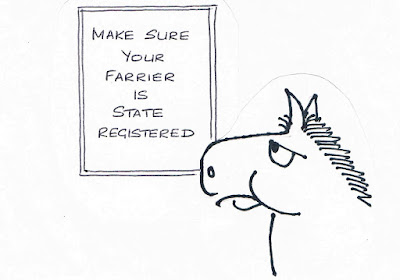
it or not, in the UK horses hoofs were protected by the Farriers Act of 1974, lower
orders like humans had to wait until 2004.

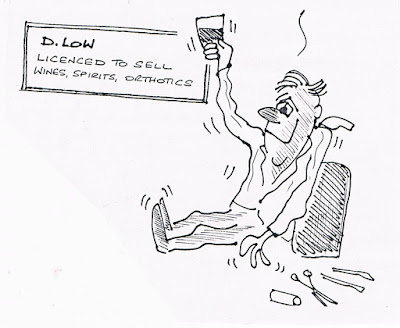
But it probably sold because it tried to be humorous
and sarcastic and was filled with cartoons - not what you normally found in
traditional po-faced podiatry literature. Quite recently I got hold of a mammoth
doctorial thesis on podiatric history and was gratified to find my humble work
frequently referenced. How on earth could something like treating feet be humorous?
Well, people like to feel elevated, and podiatry in Britain is no exception. Since
2004 new entrants to the profession need a first class BSc Honors degree to
have the title, so they spend several years at Uni, get a mountain of debt for
the next few decades, only to find that most of their working life is just
cutting old ladies’ toenails. That’s assuming anyone will employ them. So they
are forced into private practice and often fail because they lack people skills
or business skills, while the older breed continues to make a killing. There
was a lot of mileage in that story.
So the book covered attempts in the past to reach
this elevated position, and all the shysters and chancers who sold trash courses
when the titles were not protected. And how the profession started, with a
London inn-keeper who coined the term “chiropodist” when he cut corns as a
sideline to selling beer.

And then how the first corn cutters worked with the
barbers - hair at one end and feet at the other. Actually, a hobby horse of
mine, chiropody/podiatry in its British incarnation should have been a craft like
hairdressing. A manual skill, supplemented by a knowledge of science - I mean
if you put the wrong things on someone’s hair it can turn green or fall out - but
a craft. But oh no - the powers that be decided that really they were “doctors”
- well, from the ankle down. The American model moved into proper surgery and
took over what in the UK would normally be handled by orthopaedic surgeons, so this
isn’t a swipe at them; they have is a different story. But UK chiropody history
has been a battlefield. Even today, with legislation and the like, it is still
represented by four different associations who basically all hate each other, and
will stick the scalpel in at a moment’s notice.
I also wrote a book on how to run a domiciliary
practice. The plusses are very few overheads. The minuses are the limitations on
what you can do outside a surgery and the need for special aseptic procedures
for sterilization (sterilization of instruments that is). But it covered all
sorts of things, like how to take case histories. People can be very vague
about their medication - either because they just don’t know and don’t want to
know, or because they are desperate for a treatment that might be denied in a
particular environment. I remember one patient who insisted they were not
diabetic or on anti-coagulants, but after I had done the deed I noticed a green
card on the shelf - a hit-panic-button emergency card for someone with von
Willebrand disease. That’s akin to haemophilia to you. I remember contacting
the relatives and as we say in the UK wiping the floor with them.
It covered safety for female practitioners. (Tabloid
newspaper headline - “but I stabbed him with a STERILE blade says
chiropodist...”) And the business side of accounting without employing an
overrated and expensive accountant - as long as you coped with basic numeracy
to start with.
The books are long out of print, and impossibly
dated, but I earned encouraging four figure sums from both of them in their
time.
And I have happily cut old ladies’ toenails, plus a
few more advanced procedures on occasion, for the whole of my career. It has
allowed me to still pursue my other vocation, while putting a roof over the
family’s head. And I have seen off the competition time and again because I
probably mastered certain people skills in another environment that helped me
keep people sort of happy.
Just as long as they are not limping after I have
gone...
But no, I never imagined things would have worked
out like this when I first left school.
As I started off this ramble - it’s funny how life
turns out.
Subscribe to:
Posts (Atom)