Friday, April 5, 2019

The Kazoo


(from 2012)


Once or twice a month, and more so on vacation, we tend to gravitate towards the local folk clubs and – er – sing. This post is about how Occasional tried to increase his limited repertoire by mastering the technique of the Kazoo.

For the uninitiated in Kazoo-lore, you have to go back in Britain to a time to when toilet paper wasn’t soft, but hard shiny sheets. If you placed one of those sheets over a comb and hummed through it, you produced a sound. It did something strange to your lips, akin to them going numb, but well – it was a sound.  A Kazoo works on the same principle; it’s an instrument for those who can’t play instruments.

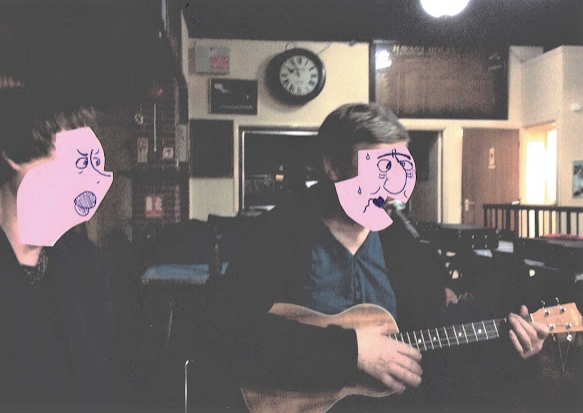
For many of my songs at folk clubs, I can plunk along on my baritone ukulele while singing, but they do require an instrumental break in the middle. A proper musician would do a show-off finger picking routine before returning to vocals. I can only strum, so a Kazoo seemed to be the answer.

The trouble was, you can’t actually sing with a Kazoo in your mouth – at least I can’t – and when it got to the break, I needed to get the thing into my mouth. The first time I grabbed it from the table, hardly missed a strum, stuck it in my mouth and blew. The wretched thing immediately shot out of my mouth across the room and hit the beer glass of a doleful man who had regaled us with a 28 verse long death ballad.

So in the interests of the current British obsession with Health and Safety I determined to fashion a Kazoo holder. You may remember seeing Bob Dylan or Bruce Springsteen do their asthmatic harmonica stuff using a special harmonica cradle in front of them. But I saw on YouTube how it was possible to make a Kazoo holder from a wire coat hanger. You twisted off the end, made a shape around your neck, stuck the two sharp ends into the end of the Kazoo – it was that easy.

They lied.

First, coat hangers may appear to bend but it is very hard to get them to bend the way you want them to. The first real concern just placing it around your neck is to avoid putting out your eye. Then you have to fix the Kazoo into the contraption so that it stays put and doesn’t swivel upside down. And then you have to try and play the thing. For some reason it becomes a variant replay on the Greek myth of Sisyphus, the King who forever failed in his attempt to roll a boulder up a hill. As you stretch out to grab the thing – without missing a beat – somehow the movements affect the improvised holder so that the Kazoo itself just shifts imperceptibly out of reach. You carry on playing your G, C and D7 as if that’s what you intended all along between verses, while chasing a wretched piece of metal piping around your upper chest. By the time you reach it, laughter (your own) has taken over, and that tragic hymn to the human condition with which you were hoping to reduce an audience to tears has been well and truly trashed.

We finally hit upon a solution involving Mrs Occasional. The first step was winding masking tape around the mouthpiece, the sort of stuff used in decorating and electrical work. It doesn’t exactly taste too good, but it does allow a normal sized mouth to hold onto the thing for as long as the instrumental break might last.

At the key second Mrs O picked the Kazoo off the table and rammed it into my teeth. She then burst out laughing. Mrs O sometimes appears to lack all sense of occasion. So I do the break with the nifty blues chords, and then I am imploring her with my eyes, and a subtlety in the notes blown that she really needs to rescue it again. Please... Sometime before the end of the evening, preferably NOW... Spitting it out onto the floor has a certain commonness about it.

So we are still working on it. I’ve tried to get Mrs Occasional to play the Kazoo instead of me, but so far she has politely declined. I mean, I help put her off with my harmonies, and thump my leg unrhythmically during her solos, but there seems a sad lack of goodwill and cooperation from her side.

And to think that folk music was all about peace and love and changing the world.

We are only one river - and Airplane

(from 2012)

It’s that folk season again – the season where Mr and Mrs Occasional will shortly be joining daughter and son in law to camp in a muddy field and strum and sing at a weekend folk festival. Occasional has no problem behaving like a superannuated hippie, although rather worryingly, Mrs Occasional was heard to mutter darkly “never again” last year. She has relented – just. But it seems a good time to consider a recurrent theme in folk music – and a popular film that trashed it good and proper!

The concept behind folk music is that this is the music of the people, made by the people. Often made very badly by the people one has to admit, but in its purest form, passing on to future generations the songs and feelings of the past – with a bit of protest and agit-prop thrown in for good measure. The river rushes on – we are part of the whole – a link in the chain – and it continues when we are gone – the sort of mixed metaphor sentiment so beloved of humanist funeral services.

Many songs try and portray this feeling. One of the best was River of Jordan, a song written by Peter Yarrow of the folk group Peter, Paul and Mary – one of the 60s acts which made folk music serious for college students before Dylan led the mass folk movement into electric pop.

The song first surfaced on a Yarrow solo album in the 1970s, but in the early 1990s Peter Paul and Mary managed to persuade the three surviving members of the Weavers – Pete Seeger, Ronnie Gilbert and Fred Hellerman – to sing it with them. The Weavers represented folk music before it was made cool by groups like the Kingston Trio in the late 50s. A huge success initially, then their politics got them blacklisted during the McCarthy era. Seeger helped write such standards as Where Have All the Flowers Gone, If I Had a Hammer, Turn Turn Turn, and introduced the western world to Wimoweh. He has lived long enough to morph into National Treasure from suspected pinko pariah in American consciousness.

So the Weavers – or three quarters of them – start the song – a line each, and then the baton is taken up by Peter, Paul and Mary. The message is clear; the torch is passed on from generation to generation, from aged folk icons to not quite so aged folk icons. It ends with a swelling chorus as if the whole world holds hands and joins in like a Coca Cola advert. I trust that fair use will allow me to quote: “We are only one river, we are only one sea, and it flows through you, and it flows through me...etc.” To quote from other contemporary sixties icons, “Yeah, yeah, yeah...”

Emotionally inspiring? Over-theatrical? Well, you can take your pick.

I lean towards the “emotionally inspiring.” But then came the film Airplane.

I am sure virtually all blog readers will have seen Airplane (and don’t call me Shirley). One of the swipes is at the sparkling pearly toothed singers of inspirational songs then current – and they use River of Jordan to do it.

The actress Lorna Patterson borrows a guitar from a singing nun. Right there is a cultural reference for those of a certain age - the tragic tale of the Singing Nun. She made a hit folk record Dominique, and so the story goes, being unworldly donated much of her royalties to the convent but without a paper trail. After leaving the convent, she was later hounded for taxes on money she claimed she never had, and ultimately committed suicide). But anyhow, back to Airplane, a nun gives Lorna the guitar and she smiles a smile designed for an orthodontics commercial (inviting a custard pie from the seriously unimpressed) – and starts singing to a little girl who is hooked up to an intravenous drip while travelling for a lifesaving transplant. All the emotional stereotypes are in place.

As Lorna gets into the swing of things, her guitar snags on the drip and pulls out the lead. The little girl starts writhing in the background, pulling a variety of spectacular faces, while her mother is oblivious and the singer blithely hollers at full throttle... We are only one river, we are only one sea...

I actually love the song. I loved the Weavers. I didn’t even mind Peter, Paul and Mary. And I certainly enjoy the Weavers remnants and PPM singing it together. I also find the Airplane parody hilarious, but unfortunately I can’t hear the song now without seeing the Singing Nun and the consequences. I must be both a true folkie believer and a closet Philistine. Call it cultural schizophrenia.

Shall we just say that I wouldn’t dare try and sing it at our folk festival weekend. Breaking into hysterics in the middle of serious folk-angst is really not the done thing on these occasions. Even by Occasional.

Tidying the Attic


(from 2012)


One of the delights of a public holiday is the incentive – with a bit of prodding from family – to “sort out” the attic.

Our family are inveterate hoarders, each individually denying it, but collectively having to fess up. The manuals on clutter advise that if something has been in storage for longer than a year, you no longer need it. Dispose. Promptly. Be Firm. Now. Humph.

So this last holiday we ventured into the attic. The first thing we managed to clear were the ancient cardboard boxes for electrical appliances that had long since gone to that great scrap heap in the sky. Even then, there was a lot of stuff.

Books. Not books we regularly use – they fill the actual rooms in the house below the attic, but ones kept “just in case” or for nostalgia reasons. Plus tons of my daughter’s stuff. She got married well over eleven years ago, and lives in a house that is larger than ours, but somehow we still seem to be the repository.

So what books did we unearth, and what nostalgic memories came flooding back? My first taped box unearthed books on conjuring. As a teenager I was well into magic tricks. My very first paid job (part-time) involved demonstrating conjuring tricks and other “toys” in a department store leading up to Christmas. I veered into magic tricks involving “thought transference” which didn’t sit all that well with my religious convictions – although I KNEW that what I did was trickery, because I KNEW how it was done. Outlets for demonstrating my “powers” were sort of limited in my circle, and the hobby took a back seat and soon disappeared off the radar. But yes – a couple of books as a distant memory – there they were, unopened for – well, quite a long time.

Then there were the textbooks on Gregg’s shorthand. Ah yes – Gregg’s shorthand. Because I planned to work for nothing for a religious charity, I needed lucrative part-time work. Secretarial – a well-meaning relative had this idea – shorthand-typing – that was it! Actually, it never was – but I went to classes and got my 100 wpm shorthand and 50-60 wpm typing. It was not exactly a macho teenage boy thing – I ended up as the only male in a class full of girls. Ten years before I had been the only male in a tap dancing troupe in a pantomime in which my father appeared – that was absolute purgatory – but now this was rather nice. As it happened, copy typing was already pushing shorthand into the cold, and anyway – I soon graduated to composing letters for others typists to produce – and at 50-60 wpm it was generally easier to knock them out myself and save on staff. But yes – Gregg’s – all those lovely short forms and perfected arguments to put down all those deluded people in the UK who still struggled with Pitman’s.

My wife’s hoard included the Montessori nursery nurse course. She started work in nursery nursing, before going to Spain to work for the same religious group as I had, when it was still illegal in the dying days of Franco. After detours in life – a major one was marrying me – she became a college lecturer in Spanish, French and Portuguese. Now “retired” she is conquering Welsh. (In-joke – Doctor to Patient – Don’t worry Mr Jones – we’ve found the problem – you’re not dyslexic – you’re Welsh!)

And the fiction books! Now we are both on eReaders, all sort of fiction gets stored in the attic – just in case. The detective fiction – ranging from the strict puzzle based on conjuring principles, with cardboardity of character to match, to modern authors where the turn of phrase is everything, and the plot incidental. Two whole boxes of Simon Brett. A TV producer and sitcom writer, who knocks out numerous tongue-in-cheek pastiches of the “golden age”. Phrases that stick in the mind – a description of the hero’s estranged wife driving a yellow mini – “She roared into the school car park like an avenging slab of butter” – a  dodgy receptionist – “a simpering teenager of 45, with hair from a color chart not supplied by God”. Those boxes got opened – a lot of tidying up time lost – before they were ultimately lugged downstairs.

Cartoons books by Styx. No-one today has heard of him – but he was very prolific in his day, and on occasion originals turn up on eBay. The jokes were thin even at the time, but the drawings were brilliant. I modelled my own style on his when illustrating a couple of books – for him it came effortlessly, for me it was hard work.

Notes and visual aids for long ago courses I taught. Actually, one of them did turn up as useful. A few years ago an anxious phone call asked if I could drop everything when illness knocked out someone taking a modern version of the same course – it was all set up and no-one wanted it cancelled. A frantic scrabble in the attic unearthed from nearly twenty years before all my notes and drawings and jokes – (very important to keep people awake) – and being self employed, I was able to make up the lost money in the days ahead. So they all went back into storage with new material thought up for the occasion. Who knows – I might get asked again in another twenty years time...

So where has it left us? All the dead cardboard boxes went into the dumpster. Bootloads of stuff went to our favorite charity shop – and we only bought a little in return – honest. But I don’t know what it is, the attic looks a bit tidier, but overall it still looks very much the same.

Possessions multiply to fill the space available for them – and for hoarders the process just keep on going. I just hope we don’t get totalled crossing the road together and someone else has to try and make sense of it all. They would have a job.

Strange Rivers


(from 2012)


Daughter and son in law and large bouncy dog have spent a week with us in our little home – which seemed even smaller after several days of trying to dry wet clothes in our British summer. Believe it or not, until a week ago there was still a hosepipe ban in some parts of the country, after what has been described as “the wettest drought in history.”

Daughter wanted to visit several places she remembered from her childhood – and with the aid of a detailed map and Occasional’s creaky memory, we manage to track down several places in the national park nearby – all hills and trees and – in current weather conditions – torrents.

Two places we visited carried memories for both her and her husband of incidents that could have put paid to their particular piece of history.

Daughter’s first. We managed to find a mountainous walk to spectacular falls that we hadn’t done for well over twenty years. The last time, when she was about ten years old, we’d crossed a small stone bridge, and she – in her wisdom and contrary to parental directive –decided to cross upstream on slippery stepping stones.

Of course, she suddenly lost her footing. She was swept under the bridge and down a series of natural steps in a rising torrent in what appeared to be a split second. What happened next remains to this day a blur. I apparently charged down the bank and partly into the stream and ignominiously hauled her out just before she would have gone over a steep fall. Immortal lines of conversation come flooding back: “I’m all WET!” “I want to GO HOME and I want to go home NOW!” (In less than kind moments – usually in company - we still remind her of the conversation all these years later!) One shaken, wet and ice-cold child with chattering teeth stomped along the bank with us back to the car and that was the end of that particular day out as I remember it now.

Then there is her husband. Shortly after they met, he and a gang of friends were travelling in the same mountainous area and overturned the car on a hairpin bend – as of course you do when you are young and feeling immortal. There have been quite a few fatalities along that stretch, but they climbed out of the vehicle with only scratches.

Within about a year of this incident he and she were married.

You do occasionally wonder – what if?

On the “what if” front, there is a John Stewart song called Strange Rivers which is all about chance and coincidence and “men making plans while the gods laugh.” While I don’t subscribe to the sentiments in their entirety, one verse comes to mind (which I trust fair use will allow me to quote here):

Did you ever turn the corner
And you wondered why you did
'Cause you haven't been that way, now
Since you were just a kid
And nothing really happened
But then you've got to say
That you wonder what would've happened
Had you gone the other way

Chorus:
There are strange rivers...etc.

Joan Baez recorded a version with a nice touch of slide guitar but she changed the hook line in the chorus to turn it into a love mantra, and sort of obliterated the point of the song.

But that’s another grumble, another story.

Silent movies


(from 2012)


I have always been fascinated by silent movies. Not just the evolution of cinema storytelling, but the very early efforts – Fred Ott sneezing in 1894, the train coming into the station at La Ciotat in 1896, which reportedly caused panic in the audience – my family thinks it all rather strange, but still make sympathetic noises and ask if I want to lie down when I go into over-enthusiastic mode.

Of course, when the movies found their feet there was a lot more to be fascinated by. I once spent a whole holiday holed up inside the Academy Cinema in London when the British Film Institute first showed the restored Buster Keaton films, rescued from a vault in his old house. One might gather that I was single at the time. I still watch the DVDs. I collected the silent films of Laurel and Hardy on standard 8mm film and was a sure hit at parties showing Liberty and Habeas Corpus. (Fortunately for L&H, their voices suited their characters and their film career survived until 1951, but those early silents remain the cream for me.) I learned to appreciate the grandeur of Griffiths’ films and the stupidity of his vision at times. And I enjoyed the epics – from CTR’s Photodrama of Creation, to the 1920s Ben Hur – with a better chariot race than the 1959 version. Even the duds had their charms – Michael Curtis’ Noah’s Ark had the Almighty talk to Noah through a burning bush and presenting him with instructions for building an Ark on tablets of stone – Curtis had obviously recently seen De Mille’s Ten Commandments, and was not too clear on his Bible stories... But the actual flood on my 8mm print was quite spectacular – and not a touch of computer graphics on the horizon.

Although it is off the point – but hey it’s my post, I’m allowed to ramble – I also love the early days of sound – when for a short while films were so dire, they have a hypnotic appeal. I have fond memories of Joan Crawford – later Grande Dame of cinema, singing – badly – and doing the Charleston even worse! Oh the joys.

But back to the silents - which brings me to the current film, The Artist.

After all the ballyhoo – for a couple of weeks there was only one cinema in my country of residence showing it. This one cinema was in a city where I used to live and work, but the costs of parking for the performance were three times the cost of a ticket, and the thought of the traffic trying to get home afterwards would have dominated the experience. But then, as it gained awards and more publicity, a few more locations took a chance – and there was a reasonable audience when I saw it earlier today.

In Britain it has had mixed reviews. Apparently patrons of a cinema in Liverpool walked out because it didn’t have any sound... Duh!

So what is the Occasional Reader’s critical review?

First, to call it a silent film in a sense is a misnomer. Music was the key. It always was. Not a just a tinkly piano with Keystone cops flickering on the screen, but a full orchestra in picture houses that were often called picture palaces, they were so grand. The music in The Artist really held everything together. And the conventions of silent film were observed, and not sent up. (I can still enjoy Mel Brooks mugging in Silent Movie, where the best joke was when the only sound spoken was by Marcel Marceau – a famous mime artiste – but The Artist was not a parody. People who watch opera don’t expect method acting, and people who watch ballet manage quite OK without dialogue – once you accept the conventions of the form). In The Artist sound gradually came in as it did in the movies. For me one of the best sequences has the “hero” who cannot speak suddenly discovering sound. A cup put on the table makes a noise, to his horror something knocked over makes a bigger noise; at the end of the sequence, he opens his mouth to scream – and nothing comes out.

At the very end he does speak a couple of words. You then realise why he couldn’t speak in movies at that time. It’s not as funny as Jean Hagen’s Brooklyn accent in Singing in the Rain (“Well of course I can talk – don’t everybody?”), but it makes the point – silent cinema had a universal language. Once sound came in everything became regionalised by language and even accents within language groups. Until of course dubbing was mastered and America did its best to take over the world of commercial film. (Which is another subject).

There was a brilliant performance by the dog, Uggie. My other half came along to please me, but found herself really enjoying the film, but especially the dog. A canine Oscar should be in order.

It was a film that also paid homage to the history of film – sequences brought back fleeting memories of the music from Hitchcock’s Vertigo, the pathos of Chaplin’s The Kid, and the ending of Welles’ Citizen Kane. There was a nifty rush to the rescue sequence – which brought back memories of the race to save the condemned man in Griffiths’ Intolerance, or the so politically incorrect Ku Klux Klan riding to the rescue in his Birth of a Nation. And there’s a lovely payoff sub-title joke at the end of it.

I hope the eventual DVD will have some extras.

Yes – silence is golden.

Now for an evening of noisy TV.

Scotland


(from 2012)


It was strange being without internet access for two weeks. How could that happen in Britain? Travelling to the rurals of lowland Scotland, that’s how.

Like many from England, I used to have preconceptions about Scotland – a land of whisky, haggis, mist, and girls with complexions like the heather.

But we had a two week vacation in Scotland, and yes – it had its moments. A stop-over in Edinburgh and then what is called the Perthshire Amber folk festival.

We flew from London. One hour in the airplane, and five hours at the airport due to fog. There was a crowd of young people with their minders, coming back from a trip to America via London. As we finally came into land at Edinburgh airport, a young voice shouted out “Wha’s tha’ smell?” It was followed by a wistful pre-teen treble: “It smells like home.” This was immediately followed by a dour teenage grunt:  “Naw – it smells like Sco’land!”

My last foray into Scotland was in the 1970s when I cycled from John O’Groats to Lands End – the two points furthest from each other in the British Isles. I caught the train to Wick, cycled to Thurso where I stayed a night, and then took just one day to cycle to John O’Groats to get my picture taken, and then cycled due south back through Wick, Inverness, along the Great Glen, ending up camping on Hamilton Race Track near Glasgow. My memory of Glasgow was at closing time, where I’ve never so many people fighting in the streets and being bundled into police wagons before or since. I put my head down and just pedalled. The second day I had left Scotland some way behind on my journey.

But Edinburgh was a new experience. Actually it was a very positive experience. We did the castle, which is impressive, both for its size and location and also for what they have packed inside it for modern tourists. In a very short time we also crammed in the Camera Obscura, a weaving exhibition, Holyrood House (seeing the spot where Rizzio was wasted by Ruthven and friends), and ended it all off in what was called the Whisky experience – where you are trundled around in barrels, allowed to smell various malts as you learned their history, and given samples to try on the spot. A most pleasant experience. To coin an old joke – I would have made it back to the hotel alright if Mrs Occasional hadn’t stepped on my hand... To follow it up with an even worse one – that night I slept like a log... (pause) ...woke up in the fire place...

But I really was tired at the end of our tourist experience. Shattered. Wiped out. The family all dragged me into an Indian restaurant, but it was very hard for me to stay awake. At the end of the meal they brought us all some mints, and a strange white wrap inside cellophane. ‘Ooh that’s kind of them’ I thought ‘to bring us a sweet pitta-bread wrap to finish with’.... and sank my teeth into a warm wet face cloth they had provided for us to clean ourselves up with before leaving. For the rest of the vacation various family members regaled me with enquires of – ‘fancy another edible napkin?’

Then the folk festival called the Perthshire Amber. The “Amber” suffix came from the autumn scenery in that part of Scotland which really was spectacular. The folk festival could be worth a post of its own – except that if you don’t like Scottish folk music it would bore you to tears. Personally I have always gravitated towards American folk music. To an outsider, America is a land of immigrants (probably all illegal according to the Comanche). But it seems to give the United States a variety in folk music not found elsewhere. But daughter is big into all things folk and Scots artiste Dougie MacLean in particular, and was singing at open mikes and attending instrument and song writing workshops, so we went along – and enjoyed it. Scots folk music has its share of the usual historical ballads (generally against the English) but a considerable amount was pastoral – and none the worse for it.

So memorable moments? I’ve already mentioned the autumn colors. But some oddments. The decorated wheelbarrow procession (Brits really do know how to do ceremonial). Spotlessly clean rest rooms (life must be sad in Britain for that to be a memorable experience). Singers like Edwina Hayes (who writes for Nanci Griffiths) and Julie Fowlis (who sings in the Disney film Brave but does everything else in Scots Gaelic). One’s own daughter at the mike. Discovering a singer-songwriter from Nova Scotia, Buddy MacDonald, whose songs are so accessible (that is, easy for even Occasional to try and sing). Bus tours with sing-a-longs all the way. Grabbing Mrs Occasional’s hand to get across a busy highway in Perth, only to find it wasn’t Mrs Occasional... Workshops for weird guitar tunings, bodhrans, and song writing. A young Scotsman in full national regalia guarding the gate for one event, when snow suddenly came down. “You could do with a coat” shouted someone from the queue – “I ca’ doo wi’ a pair o’ troosers” came the doleful reply.

So it’s back to the internet. A couple of weeks seems a long time in Cyber-land. Old posts are generally dead posts, so I must take up reading them again and try and remember who I am supposed to be on the various blogs and message boards I support under different names.

But it’s also back to a mountain of washing the size of Mount Everest (including for my elderly mother who we left with carers while away). Back to a telephone answering machine full of plaintive patients and religious queries. Back to a zillion emails – 99% junk but some gold as well, requiring urgent attention.

But after just a few hours back, it seems like I’ve worked around the clock on catch-up. And I’m again tired – shattered – exhausted – bushed – dead-beat – worn-out – all-in.

You know – I really do think I need a vacation.


Oh go on then - heckle!


(from 2012)


I love a good debate. Mrs Occasional generally can’t stand them. We have to agree to differ.

For me, the quickness of repartee and the swift put-down from either side makes for stimulating entertainment, even if both sides ultimately remain convinced of their original positions.

When I lived in London I used to visit what was called Speakers Corner. This was just by Marble Arch, where criminals had been executed a few hundred years before. Here, people of all persuasions – generally extreme – could stand on a soap box (literally) and sound forth. At the time, only talk of outright treason was banned. The crowds would “debate” with the speakers. There were political views from extreme right and left, wild-eyed evangelists predicting dire destinies for the boisterous crowd, an old guy tattooed from head to foot who claimed to have been Al Capone’s driver, and a sallow faced man with bad teeth who was adamant that the entire world’s sexual depravity was caused through eating too many beans. For a teenager, this was all good free entertainment.

It couldn’t really be called debate by any stretch of the imagination, but one of our favorites was the yodelling woman. She was short, rotund, of indeterminate age, and she just went from audience to audience and – well – yodelled. Nothing could be guaranteed to put an evangelist off his text quicker than the yodelling woman. Having reduced one to a gibbering wreck threatening hell and damnation, she would move on – and the bulk of the crowd with her – to see what the fate of the United Workers Liberation speaker would be. It would be similar.

Sometimes though, it is the quick witted put-down that stays in the mind. I remember at a folk festival listening to an earnest singer-songwriter from a remote Canadian fishing village. After one intense ditty on the human condition, he explained how, where he came from, there were only two choices – to become a musician or a fisherman... A drunken voice called out from the back – “So which did you choose?” I think “nonplussed” is the best word to describe the reaction.

Sometimes it works the other way, when a heckler is upstaged by the response. Back in the late 1960s when Britain was struggling with Ian Smith’s unilateral declaration of independence for what was then called Rhodesia, British Prime Minister Harold Wilson was explaining at a televised meeting what they were trying to do for the black majority. An angry voice cried out from the crowd “All you’re interested in is a load of ***** savages!” Quick as a flash, Wilson shot back on primetime TV – “Yes, and we even allow them into our meetings”.  You could almost hear the sound of horrible great skid marks as the heckler was silenced.

Today, we are probably all conditioned to live debate on TV from chat shows, including the bear-baiting kind associated with USA’s Jerry Springer or UK’s Jeremy Kyle. Back in the 60s the style was pioneered in Britain by a very young David Frost. They would get someone controversial into the studio for an interview, and fill the audience with their opponents. The armchair audience would settle back in comfort at home to watch the carnage. Only sometimes there were surprises.

Wafting back through the decades was a classic example featuring Sir Oswald Moseley. Moseley was a controversial figure in British history; he led the British Fascist party in the 1930s, his followers wore black-shirts, and his oratorical style owed a great deal to Hitler and Mussolini, as did his politics. He was locked up by the British authorities for the duration of the war. But here he was in the 1960s, a totally unrepentant old man who was still embroiled in far right politics. So the David Frost program loaded the audience with what could only be described as a busload of ardent Zionists. Historically, they had every good reason to hate everything Sir Oswald stood for. It should have been a TV massacre, what with Frost at his young incisive best. Only, for this viewer, it didn’t turn out that way.

Moseley dodged and parried with skill, and kept his cool, while the audience got increasingly heated, and Frost made the mistake for the era of not even attempting to appear fair and even-handed as interlocutor and moderator. One memorable moment – someone in the audience had been shrieking abuse at Moseley, and Frost’s attempts to silence them had fallen on deaf ears. Moseley turned full face to the camera. “You asked me why we had the black-shirts in the 1930s” he said. He gave a withering smile full camera and pointed a pudgy finger straight into it – “it was to throw people like you out of our meetings!” There was a shriek of anguish and rage, and the program ended with Moseley sitting Buddha like and serene while chaos continued around him. I hold no truck with Moseley’s views, but from a debating point of view, on live TV, he knew how to use the media – even better than Frost did at the time in my estimation.

Perhaps the debate I enjoyed most of all was a religious one. A member of the religious group I support was once invited to a live TV debate to represent their views before an audience made up entirely of theologians. The location was at a theological college in a university city. The program was fittingly called “Daniel in the Lion’s Den.” He was to explain his beliefs, and then defend himself from the combined efforts of the leading lights of the established Church.

The “lions” started off quite condescending and dismissive, but as “Daniel” got them down to specifics, it got rather interesting. He invited his audience to turn up and read a verse in Matthew 24 with him. There was a rustle of embarrassment – none of the theologians making up the audience had actually brought a Bible with them. So Daniel, laboring the point quite effectively, produced a stack of Bibles and helpfully offered to hand them out to the audience. Their condescending manner evaporated into something a lot testier as the debate progressed – Daniel reading verse after verse direct and his audience, wrong-footed, trying to quote from memory. It ended with the final comment Daniel was allowed (quoting from memory) – after extolling how his own faith had given him a purpose, and strengthened his relationship with God, he turned on his audience – “your belief has so weakened your faith that not one of you even bothered to bring a Bible with you!” There was howl of annoyance from the assembled worthies, and the program faded out to Daniel plying them with question after question machine-gun fashion, and refusing to let them escape when they didn’t answer to his satisfaction.  Yes, a memorable program.

On a personal note, about ten years after that program, I had the experience of visiting the same theological college with a colleague to represent the same religious views in another debate. This time it was with their third year students, moderated by a couple of teachers, and no, it was not recorded. This time they had Bibles. I concentrated on history – my subject even then – and we debated the finer points of translation for key proof texts from either side. It was amicable, there was tea and cakes afterwards, and it was moderated extremely fairly by a college official. I am sure we all went away as fixed in our positions as we had been before we started. And no – there were no memorable put-downs on this occasion.

I really did behave myself for once.